Recurring means something happens again and again, often on a pattern. Reoccurring means something happens again, without saying how often. Both words are close, and many people swap them. For most writing, recurring is the safer choice.
Recurring Meaning and Definition
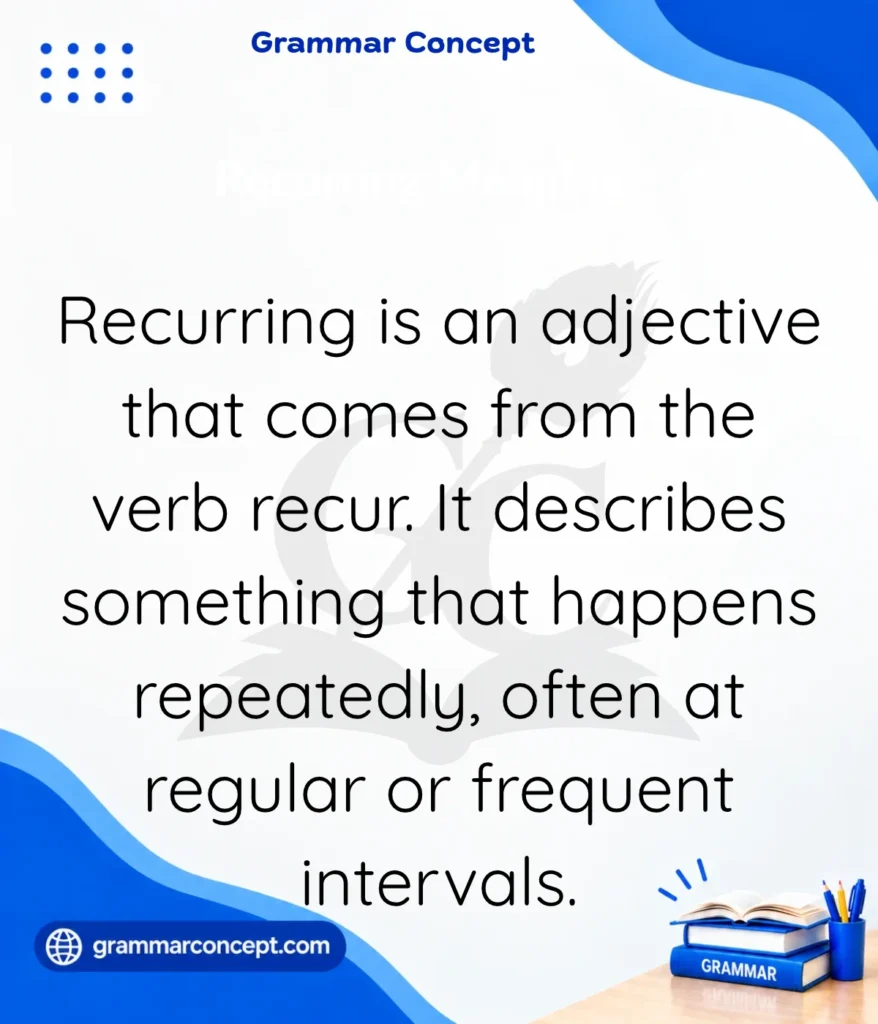
Recurring is an adjective that comes from the verb recur. It describes something that happens repeatedly, often at regular or frequent intervals.
The word comes from the Latin recurrere, meaning “to run back.” That is why it suggests a repeating pattern. It pairs well with words like theme, dream, problem, payment, and decimal.
Recurring Examples in a Sentence
Here are a few examples that show how recurring works in daily writing:
- Her recurring dream always ends at the same cliff.
- Late shipments became a recurring problem this spring.
- The gym charges a recurring fee on the first of each month.
- One divided by three gives the recurring decimal 0.333…
More Post: Hola or Ola
Reoccurring Meaning and Definition
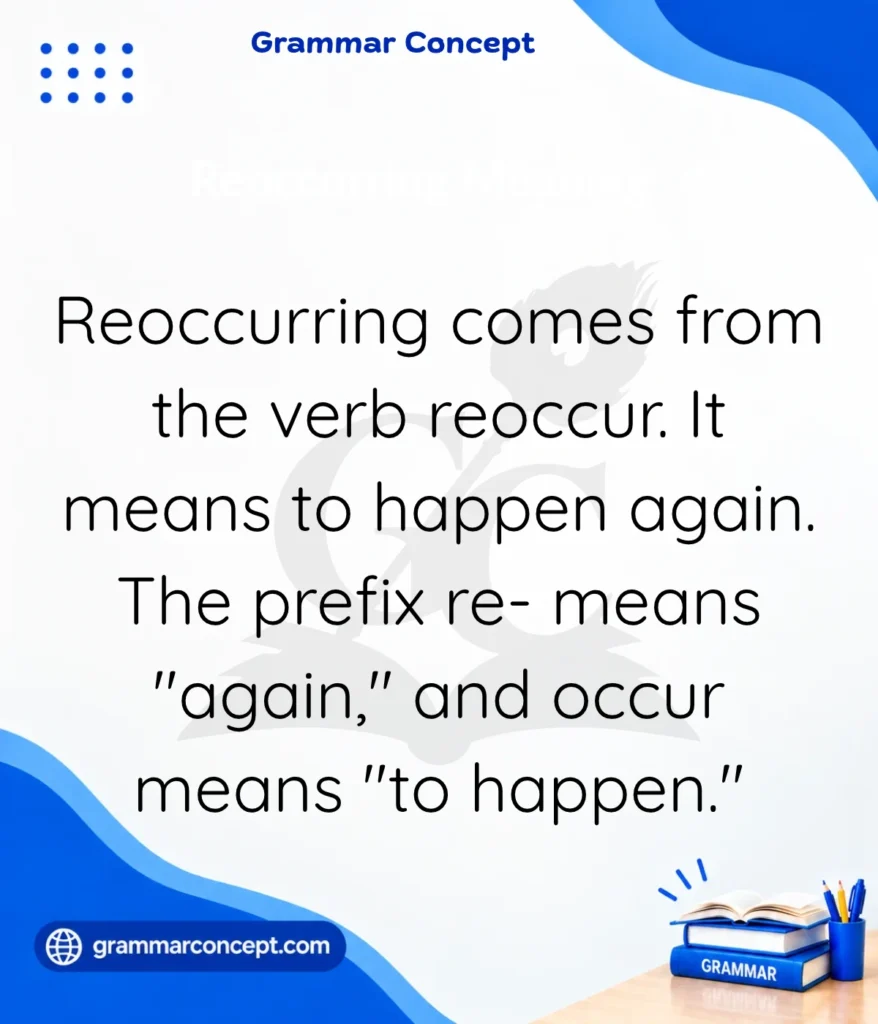
Reoccurring comes from the verb reoccur. It means to happen again. The prefix re- means “again,” and occur means “to happen.”
Unlike recurring, it does not hint at a pattern. It simply says the event came back. It is also far less common, and some dictionaries prefer recur instead. When unsure, “happen again” is a clean substitute.
Reoccurring Examples in a Sentence
These examples show reoccurring used for a repeat with no clear schedule:
- The team fixed the bug, but it started reoccurring on Friday.
- Doctors hope the infection will not reoccur after treatment.
- We added a barrier to stop the flooding from reoccurring.
- The glitch was reoccurring during the second test.
More Post: Driver’s License vs Drivers License
Reoccurring vs Recurring Differences Chart
| Feature | Recurring | Reoccurring |
|---|---|---|
| Basic meaning | Happening again and again | Happening again |
| Suggests a pattern | Yes, often | No |
| Base verb | Recur | Reoccur |
| How common | Very common | Less common |
| Typical use | Theme, payment, dream, decimal | One-time or irregular repeats |
| Example | A recurring monthly bill | A reoccurring error after a fix |
How to Choose Between Recurring or Reoccurring
Ask one question: does it repeat on a pattern? If yes, pick recurring. If it simply happened again, reoccurring fits, though recurring still works.
Fixed phrases always take recurring. Think of recurring revenue, recurring character, and recurring decimal. Using reoccurring in these would sound odd.
Quick Memory Trick
Think of a heartbeat. It repeats on a steady pattern, so it recurs. Now think of a one-off glitch that returns once. It reoccurs.
Another shortcut: recur has cur, like a current that keeps running. That matches its Latin root, “to run.”
Conclusion
Recurring and reoccurring both mean “happening again,” but recurring adds the idea of a pattern. Use recurring for repeats you can expect, and reoccurring for a simple return. When in doubt, choose recurring, or just write “happen again.”
More Post: Appreciative Of vs Appreciative For
FAQ’s About Recurring vs Reoccurring
Is it recur or reoccur?
Both mean “to happen again.” Use recur for repeated or regular events, and reoccur for a simple repeat. When unsure, recur is the safer pick.
Is “reoccurring” a real word?
Yes. Reoccurring is the present participle of reoccur, a verb in use since the 1700s. It is real, but less common than recurring.
Is “reaccuring” or “reccuring” correct?
No. Both are misspellings. The correct forms are recurring (one c, double r) and reoccurring.
What is the difference between recurring and recurrent?
Both mean “happening repeatedly.” Recurrent is common in medical writing, like recurrent infection. Recurring is the more general choice.
What does “recurringly” mean?
Recurringly is a rare adverb meaning “repeatedly.” Most writers use repeatedly or recurrently instead.

Hi, I’m Dylan Ross, the author of GrammarConcept.com. I make English grammar, grammar rules, and sentence structure easier to understand through simple explanations, practical examples, and helpful guides. My goal is to help students, writers, and English learners improve their grammar and communicate with confidence.