Afterward vs afterwards is an easy call: both words mean “at a later time.” They are adverbs, and you can use either one. We usually write afterward, and it fits every sentence where afterwards does.
Below, you will find the meaning, simple rules, and clear examples.
What Does Afterward Mean?
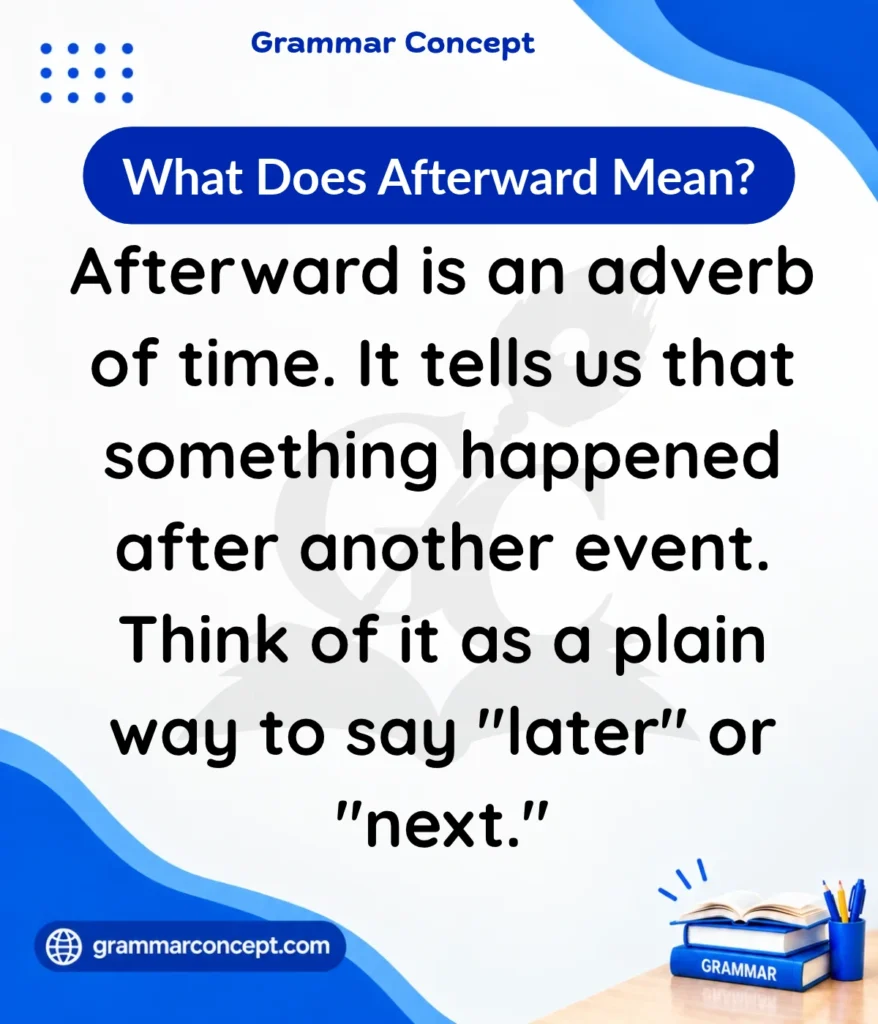
Afterward is an adverb of time. It tells us that something happened after another event. Think of it as a plain way to say “later” or “next.”
It works in speech, emails, school papers, and business writing. Close synonyms include later, then, next, subsequently, and thereafter.
- We ate dinner and watched a movie afterward.
- Afterward, she called her mom.
- Soon afterward, the rain stopped.
More Post: My Father and I or My Father and Me
What Does Afterwards Mean?
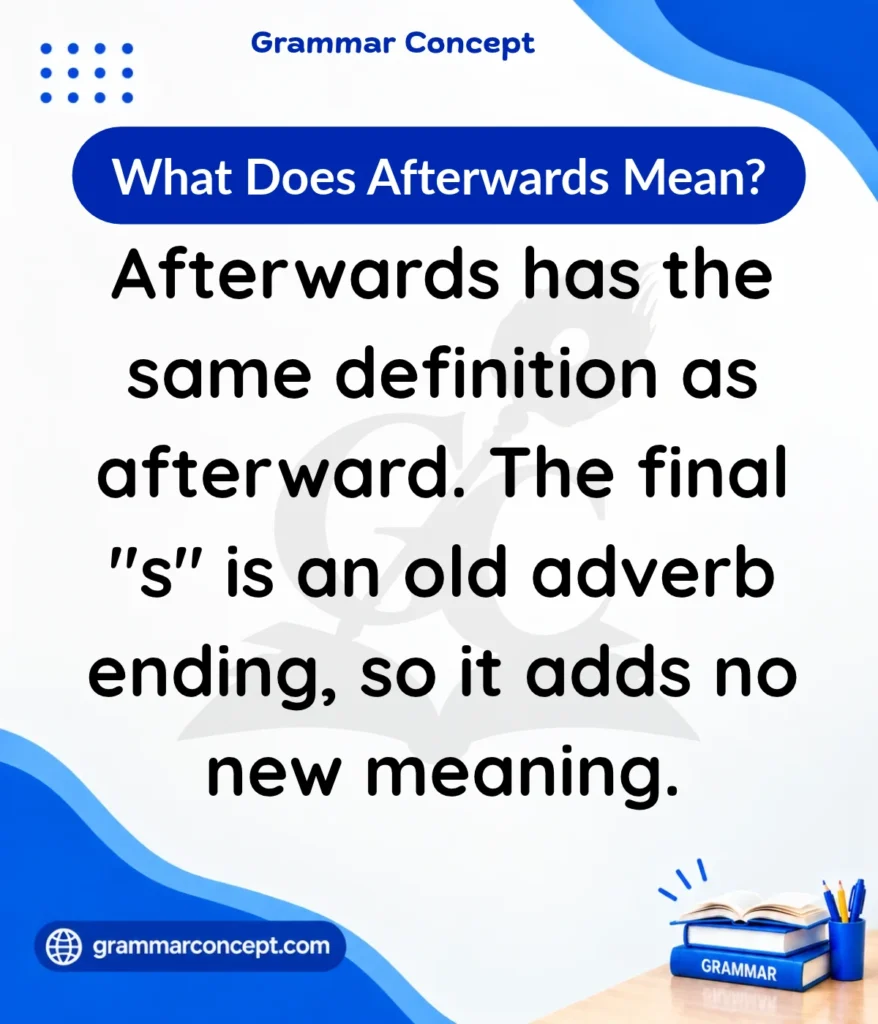
Afterwards has the same definition as afterward. The final “s” is an old adverb ending, so it adds no new meaning.
You will see it often in books, news stories, and everyday talk. It is never a mistake.
- The meeting ended, and we left shortly afterwards.
- Afterwards, he felt much better.
- Long afterwards, the town still remembered the storm.
More Post: Linchpin vs Lynchpin
Afterward vs Afterwards Difference Chart
| Feature | Afterward | Afterwards |
|---|---|---|
| Part of speech | Adverb | Adverb |
| Meaning | At a later time | At a later time |
| Correct to use? | Yes | Yes |
| Can start a sentence? | Yes | Yes |
| Common pairing | Shortly afterward | Shortly afterwards |
Afterward vs Afterwards Usage Rules
Follow these simple rules when you write:
- Pick one form and stay consistent in the same article.
- Place it at the start, middle, or end of a sentence.
- Add a comma when it opens a sentence.
- Treat it as an adverb. It describes verbs, not nouns.
Do not confuse these with afterword. An afterword is a noun. It is a closing note at the end of a book.
A quick memory trick: an afterword is a section made of words in a book. A common slip in drafts is mixing both forms in one piece.
Afterward vs Afterwards Examples in Sentences
Here are side-by-side examples that show both words in the same setting:
- Casual: Afterward, we grabbed coffee. / Afterwards, we grabbed coffee.
- Work: We reviewed the plan and shared notes afterward. / We reviewed the plan and shared notes afterwards.
- News style: The mayor spoke, and questions followed shortly afterward. / The mayor spoke, and questions followed shortly afterwards.
- Storytelling: He never spoke of it again afterward. / He never spoke of it again afterwards.
- Book note: The author thanked her editor in the afterword.
More Post: There Have Been or There Has Been
FAQ’s About Afterward vs Afterwards
Is it afterward or afterwards?
Both are correct and mean “later.” Afterward is more common in the US, while afterwards is more common in British English.
What is the difference between afterward and afterword?
Afterward is an adverb that means “later.” Afterword is a noun for a closing section at the end of a book.
Is afterward formal or informal?
Afterward is suitable for both formal and informal writing. It is commonly used in American English, while afterwards is more common in British English.
Can afterward and afterwards be used interchangeably?
Yes, afterward and afterwards have the same meaning and can generally be used interchangeably. The choice depends mainly on regional spelling preferences.

Hi, I’m Dylan Ross, the author of GrammarConcept.com. I make English grammar, grammar rules, and sentence structure easier to understand through simple explanations, practical examples, and helpful guides. My goal is to help students, writers, and English learners improve their grammar and communicate with confidence.