Along or a long? Use along for movement, position, or company, as in “walk along the river.” Use a long to describe time, distance, or size, as in “a long time.” Speech blends the two sounds, so this guide shows the difference, usage, and examples.
What Does “Along” Mean?
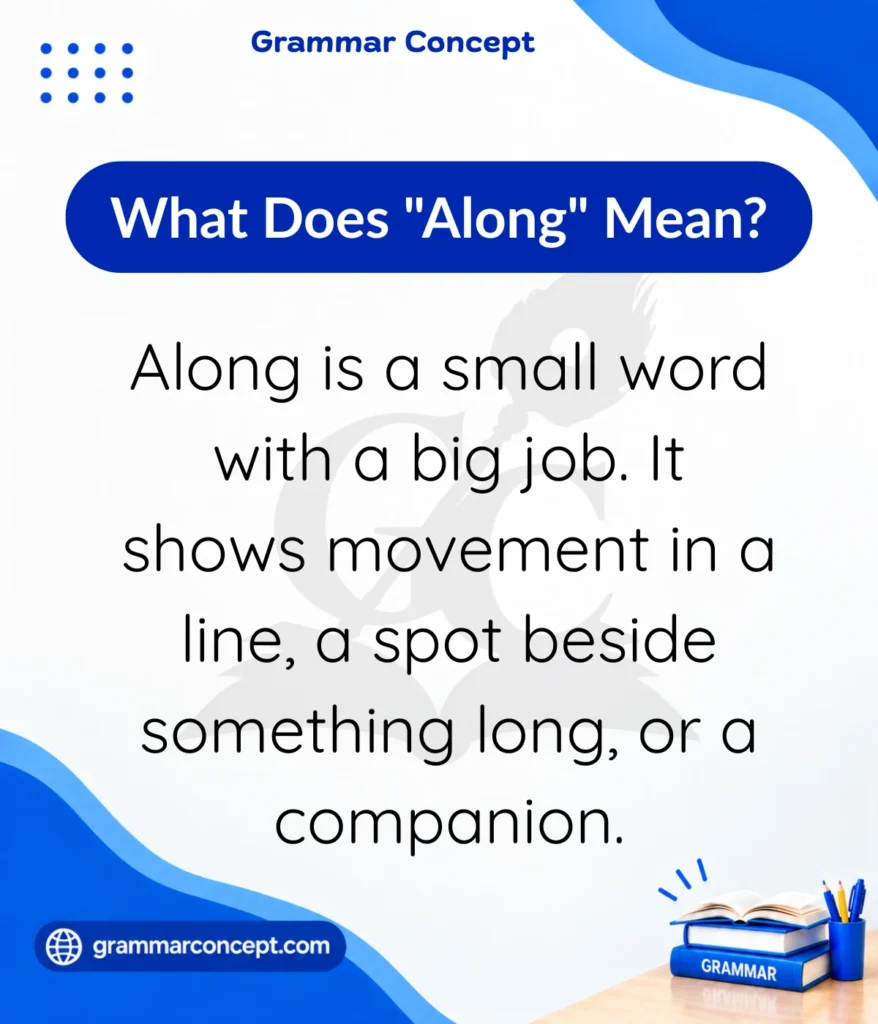
Along is a small word with a big job. It shows movement in a line, a spot beside something long, or a companion. Merriam-Webster lists it as both a preposition and an adverb.
The word traces back to Old English andlang, built from a word for “against” and lang, meaning long. That shared root is one reason along and a long get tangled.
Along as a Preposition and Adverb
As a preposition, along comes before a noun and shows a path or position:
- We walked along the beach.
- The chairs were lined up along the wall.
- We stopped along the way for lunch.
As an adverb, along stands alone or pairs with with. It means forward, or together with someone:
- Please come along.
- She brought her friend along.
- He sent the form along with the package.
More Post: Begin vs Began vs Begun
What Does “A Long” Mean?
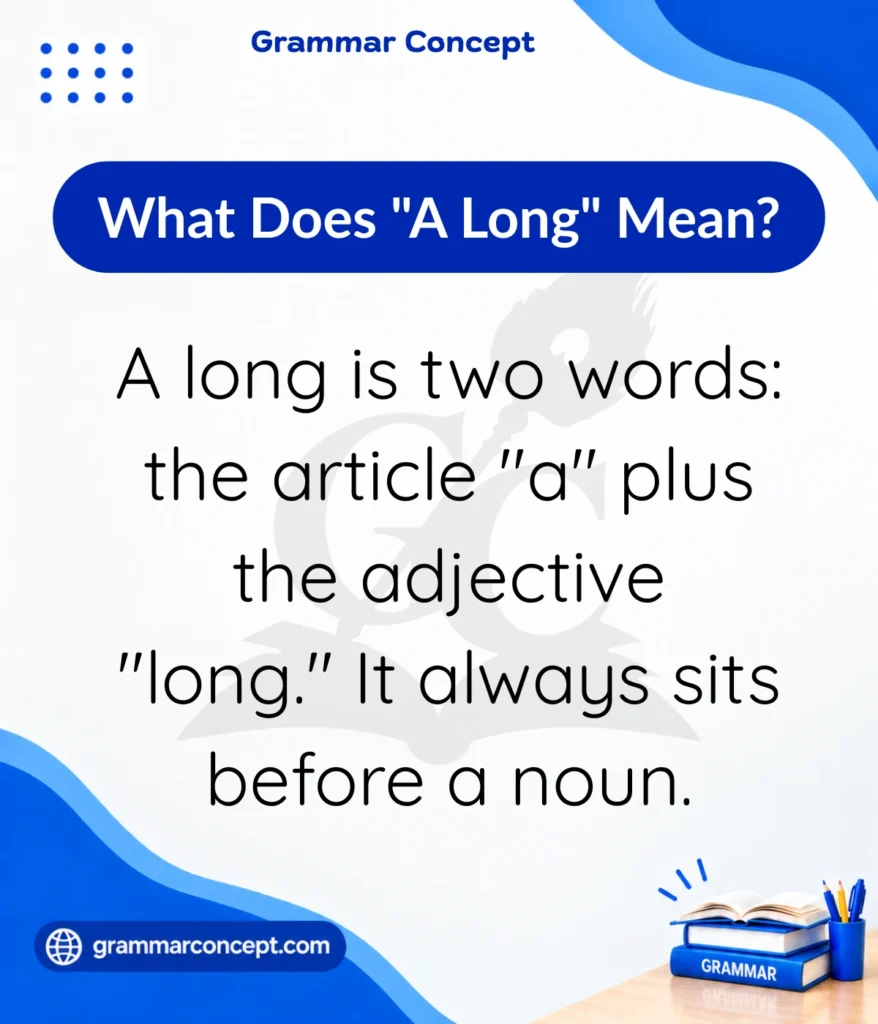
A long is two words: the article “a” plus the adjective “long.” It always sits before a noun. It tells us how much time, distance, or length something has.
If you can swap in “a short,” the phrase is a long. “A short time” works, so a long time is right. “Along time” does not, so it is wrong.
“A Long” + Noun: Time, Way, and Distance
These are the most common a long phrases:
- a long time
- a long way
- a long day
- a long meeting
- a long walk
For compound adjectives, hyphenate the compound, not the article. Write “a long-term plan,” never “a-long plan.”
More Post: Had vs Have vs Has
Along vs. A Long Chart
| Feature | Along | A Long |
|---|---|---|
| Words | One word | Two words |
| Type | Preposition or adverb | Article + adjective |
| Meaning | Movement, position, company | Time, distance, size |
| What follows | A place or “with” | A noun |
| Example | Walk along the river | A long walk |
Quick Test to Choose Between Along and A Long
Try this replacement test. Swap the phrase with “for a long time” or “a long way.” If the sentence still makes sense, use two words.
Here is a memory trick: A = Amount. If you measure an amount of time or distance, write a long. If you mean beside or together, write along.
Common Mistakes and Correct Examples
Most errors happen when we type fast. Compare these pairs:
- Wrong: I haven’t seen you for along time. Right: I haven’t seen you for a long time.
- Wrong: We had along meeting. Right: We had a long meeting.
- Wrong: Come along your sister. Right: Come along with your sister.
Similar spacing traps include a lot (never “alot”), every day vs. everyday, and all together vs. altogether.
More Post: Someone or Somebody
FAQ’s About Along or A Long
Is it “along time” or “a long time”?
Use a long time for duration. “Along time” is incorrect because along means beside or moving with, not duration.
When is “along” correct?
Along is correct for movement, position, or company. For example: “He walked along the shore” or “Come along to the meeting.”
Why does “a long” sound like “along” when spoken?
Speech runs words together, so “a long” blends into along. In writing, follow the meaning: time or distance needs two words.
Can a grammar checker fix this reliably?
Many checkers catch it, but they can miss odd cases. The replacement test plus reading aloud is the safest habit.
Are there formal alternatives to “a long time”?
Yes. In academic or business writing, try an extended period or a lengthy period.

Hi, I’m Dylan Ross, the author of GrammarConcept.com. I make English grammar, grammar rules, and sentence structure easier to understand through simple explanations, practical examples, and helpful guides. My goal is to help students, writers, and English learners improve their grammar and communicate with confidence.